Category: General Medicine
Dancing bears and basketballs
This video proves one thing: you see what you expect to see.
And if you don’t expect to see it, then your mind ignores the blatantly obvious opportunities/discoveries/experiences that are literally dancing right in front of you.
So your #1 job right now – as you study for exams, dissect cadavers and keep up with the schedule of med school – is to protect yourself from mediocre expectations.
Expect to discover a cure for cancer or AIDS in your first semester of 1st year Physiology.
Expect to write a groundbreaking paper when you’re working on your first Biochemistry lab report.
Expect to discover something that’s been hiding in plain site and baffling great minds for hundreds of years.
Someone has to discover it.
Why can’t it be you? And why can’t it be you right now?
Expect to see and do outrageously crazy things in this moment…and you’ll be stunned by what you suddenly start to notice.
Medicine is a language
Medicine is a language that you just have to learn.
But.
How you use that language is completely up to you.
Medical student for 5 years…Doctor…Gruelling hours as an intern…Rotations…Specialisations…Fellowship exams…Consultant… Lecturing…
This is just one tiny corner of the Ecosystem which is Medicine.
There are countless examples of people who have carved out or created unique niches using their mastery of the language of medicine.
And the same is true for you.
Don’t be discouraged by the uninspiring picture being painted for you by dull/tired lecturers.
Learn the language of Medicine…and then use it to communicate/create an amazingly inspiring reality that this world has never seen before.
Connect the dots
Medicine is a game of connecting dots.
It’s taking the information you read in Guyton about the action of erythropoietin on the bone marrow to produce more proerythroblasts…and then linking that to the biochemical action of Hypoxia Inducible Factor -1 on the erythropoeitin gene in conjunction with the Lac-Operon model…and the new relate that to the clinically significant features of a fractured clavicle…and connect that to the anaemic looking 5 year old sitting on the bus opposite you.
The name of the game is “connect the dots”.
But to play, you’ve got to have some dots.
So when you study, don’t worry about how much you don’t remember…focus on gathering and keeping as many dots as you can.
And trust that somehow the dots will connect over time.
Here’s the plan
Show up and do the work.
5 years from now I will graduate as a doctor at the age of 40.
And the key to doing that is just showing up and doing the work.
Of course, the trick is in defining what “the work” is.
For most Medics, the work is simply to make it through medical school…which is no small feat. Because to do that means learning and mastering several new languages with extensive vocabulary that you need to internalise: gross anatomy, embryology, histology, physiology, biochemistry, pharmacology etc
And what that really comes down to is finding “the Bible” for each subject (eg Physiology = Guyton&Hall) and making sure you have memorised and understood every single page in it.
But then what?
You’ll pass the subjects, acquire the knowledge and skills to save another person’s life, and then once you graduate…you’ll become a highly skilled cog in a broken health care machine somewhere, competing (and complaining) with all the other cogs about how tired/frustrated/overworked/underpaid/overwhelmed you are.
Why?
Because if all you’ve done is master the same path that a million other doctors have done…then you have no leverage and you have to play the hand you get dealt by the system.
Rather than learn how to play the game better, I’ve decided to play a different game altogether.
A game where I have enough leverage to make a difference. A game where I carry on the arc of every pioneer who preceded me in making a dent in the Universe…and not just a difference nd few more letter after my name.
I’ve got a plan, and this blog post is the first step in me showing up to do the work…where getting through med school is only the beginning.
More on this tomorrow.
The Blood Typing Game
“…one train may hide another.” – Kenneth Koch
As part of getting up to speed for rejoining the medical school later this year, I’m working my way through Ross and Wilson’s Anatomy and Physiology in Health and Illness (10th edition). This is an example of the idea that to get through any topic in medicine, all you need is one good book to master.

But what was interesting about today’s study session is that I was working my way through chapter 2 – Introduction to the chemistry of life – revising fundamental concepts about physics/biology/chemistry, atomic structure, learning about protons, neutrons, electons, quarks etc… and I found myself somehow looking up the youngest Nobel prize winners of all time, and what they had to do be awarded one.
And then I stumbled across The Blood Typing Game.
The Blood Typing Game

This is a really amazing game that teaches you about blood types, cross matching and gives you the opportunity to save patients by using your knowledge in clinical situations.

The only trouble was that my knowledge of everything to do with blood was quite sketchy. So after looking things up online and quizzing my big brother who’s a clinical embryologist and pharmacologist, the next thing I knew I was in a lab being taught the basics of blood groups, blood typing and cross matching. Awesome!
So I’m going to share what I’ve understood so far as a way of seeing how much of it I’ve understood. Because many times the best way to actually learn something is by teaching it.
So…what exactly is blood?
First, an excerpt from the Nobel.org tutorial on blood:
Before Nobel Prize awarded Karl Landsteiner discovered the ABO human blood groups in 1901, it was thought that all blood was the same. This misunderstanding led to fatal blood transfusions. Later, in 1940, Landsteiner was part of discovering another blood group, the Rh blood group system. There are many blood group systems known today, but the ABO and the Rh blood groups are the most important ones used for blood transfusions. The designation Rh is derived from the Rhesus monkey in which the existence of the Rh blood group was discovered.
Followed by a definition:
blood [bləd/]. noun. the red liquid that circulates in the arteries and veins of humans and other vertebrate animals, carrying oxygen to and carbon dioxide from the tissues of the body. The adult human body contains between 4 and 6 litres of blood.
This red liquid we call blood is made up of four components:
- Red blood cells – contain haemoglobin that binds oxygen which it transports around the body…whilst it also removes CO2 from body tissues. Sort of like a Milkman and Garbage collector rolled into one.oxygen to the entire body, and remove carbon dioxide from
- White blood cells – fight infection. They protect you from everything they think is a threat…an approach that can be a threatening event in an of itself.
- Platelets – form blood clots.
- Plasma – a fluid containing salts and various types of protein (e.g antibodies)
Understanding the ABO Rh Blood Group Systems

There’s so much you can study just about the nature of blood and even a fascinating article that asks the question: why do we have blood types? I’ll list all my references at the bottom of this blog post.
But from a practical and clinical perspective, here’s what you can use right now.
Of the 35 different blood group systems, the main two systems of classifying blood are: ABO and Rhesus.
The ABO blood group system is where we get our basic blood type classification of A, B, AB and O.
The Rhesus blood group system is where we get the ‘positive’ or ‘negative’ aspects of our blood type. So if someone says they’re “B positive”, they’re actually saying that their blood type is “B Rhesus positive”.
And both of these blood group systems use the presence or absence of specific antigens on the red blood cell to determine what it’s blood type is.
A Quick Primer On Antigens And Antibodies
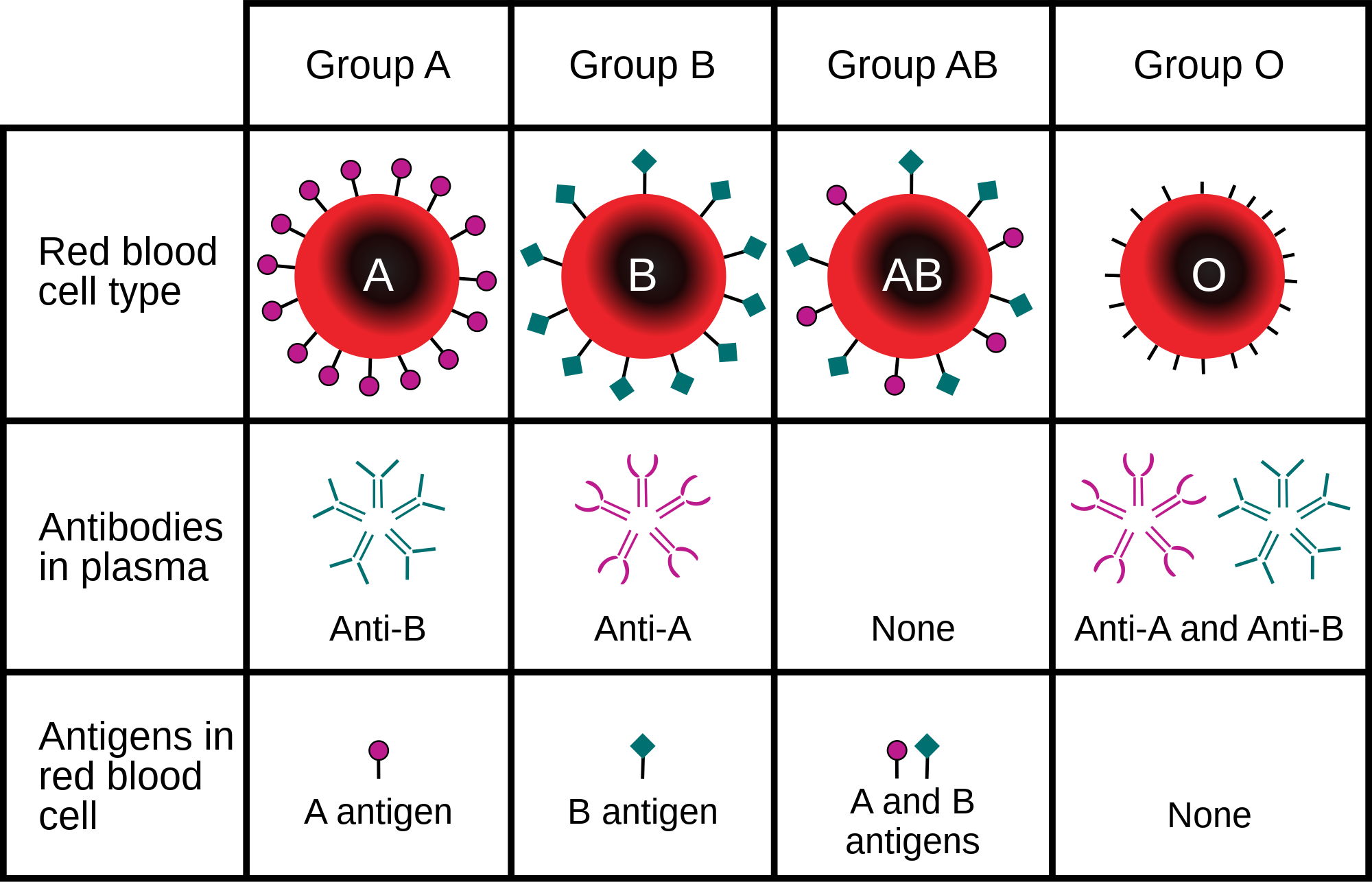
Simply put, an antigen is defined as being: any substance that causes an immune system to produce antibodies against it.
And an antibody (Ab) is defined as being: a large, Y-shaped protein produced mainly by plasma cells that is used by the immune system to identify and neutralize pathogens such as bacteria and viruses.
So if you look at blood group A in the table above, you’ll see that the red blood cells has A antigens but no A antibodies. And so there are no A antibodies (aka Anti-As) present in the body that will attack its own blood cells. It does, however, have B antibodies (Anti-Bs) in the plasma around the red blood cells. And so if any blood containing B antigens is introduced to this person’s blood stream, it will trigger a massive attack from the person’s hyper vigilant B antibodies…resulting in what’s called a haemolytic transfusion reaction.
Pretty nasty stuff.
So it’s really important that you do accurate blood typing and cross matching before you give blood to anyone. And best of all, it’s extremely easy to learn…especially if you practice by playing the Blood Typing Game on Nobel.org
Learning How To Blood Type In The Lab

In the lab, we took a sample of blood and made 4 separate drops with it on a piece of white tile.
We then lined up our anti serums …those coloured bottles at the top of the picture… which each contained a specific antibody. In order from left to right: Anti-A, Anti-B, Anti-AB and Anti-D (Rhesus antibody).
Each anti serum was assigned to one of the drops of blood, mixed in with the blood and observed.
Here’s what we found:

So this meant that the blood sample had a B-Antigen (hence the reaction with both Anti-B and Anti-AB serum). It also had a reaction to the Anti-D serum, where D is the primary antigen in the Rhesus blood group system…you can read about the other Rhesus antigens here.
And so our unidentified blood sample proved to be B Rhesus Positive.
Because if it reacts to the antibody serum, then it has the antigen being targeted by the antibody.
A Quick Point About Cross-Matching
Alongside blood typing, it’s important to cross-match blood before using it in a transfusion.
This means that if your patient has been typed as being B Rhesus positive (B+) and your blood donation sample has also been typed as being B+, the final step before using it in the transfusion is to crossmatch it.
This is where you spin your patient’s blood sample in a centrifuge so that the blood separates into plasma at the top and red blood cells at the bottom.
You then take a sample of the plasma – the part that has the free floating antibodies – and place a drop of the plasma on a drop of the blood donor sample.
If there’s no reaction, then you can use the blood. But if there is a reaction – regardless of how you matched the samples during blood typing – do not proceed with transfusion.
One Train May Hide Another (aka Unresolved Questions)
This blog post has rambled on quite a bit, not unlike the rambling nature of my study session today that took me from protons and neutrons to playing the Blood Typing Game to a practical session in the lab learning how to do it.
On the one hand, taking so much time to construct a blog post feels kind of wasteful as I could be zooming ahead through Ross and Wilson gathering more knowledge.
But my gut instinct is that if I simply trust that I will learn what I’m supposed to learn each session, that everything will somehow work out for my good.
Now as well as all the cool things I’ve learned, I also was left with a couple of unresolved questions that I’ll post here as they may be the key to massive Nobel-prize worth innovation.
- Why do some people not have any blood type (ala the Bombay phenomenon)?
- Why does blood type AB not have any antibodies in the blood plasma?
If you’ve got any thoughts about these questions or useful links, please share them in the comments below as I’d love to hear your thoughts on this.
Thanks for reading and I’ll see you in the comments!
Next steps:
- Go and play the Blood Typing Game right now!
- Post your score and any thoughts about this post in the comments below
- Bonus: download my handy chart for figuring out the blood groups
References and further reading:
- One Train May Hide Another: Poem by Kenneth Koch
- The Youngest Nobel Prize Winners: Photos
- Nobel.org: The Blood Typing Game
- Why do we have blood types?
- Blood Work: A Tale of Medicine and Murder in the Scientific Revolution
- Hemolytic Transfusion Reaction
- Rh Blood Group System